Home / Oral surgery
Oral surgery – wisdom teeth and difficult extractions
Some teeth cannot simply be pulled: wisdom teeth stuck in the jaw, teeth that never erupted, or broken teeth with curved roots. We remove these surgically – carefully planned, as gently as possible and with respect for nerves, bone and neighbouring teeth.
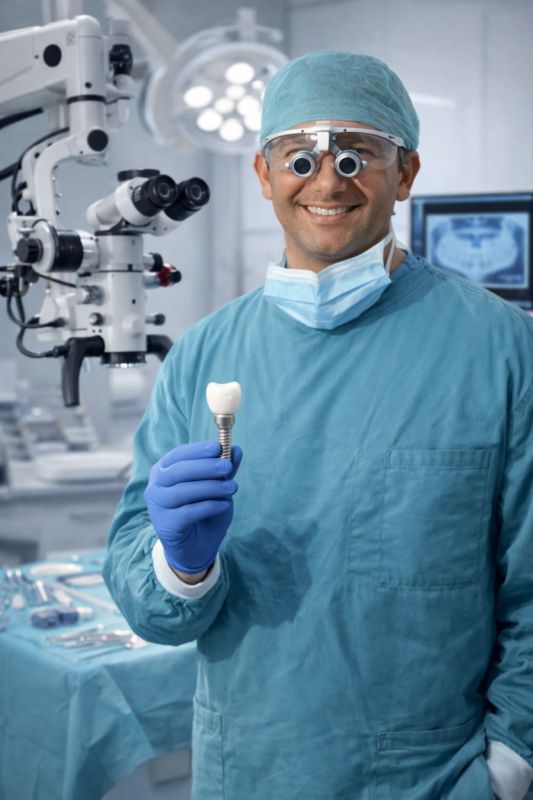
Surgical tooth extraction
Surgical extraction is needed when a tooth is deeply decayed or broken, has strongly curved or long roots, or is fused to the bone. The gum is opened briefly, the tooth is divided if necessary and removed in sections. This preserves as much bone as possible – important if an implant is planned later. Finally the wound is closed with fine sutures.
Wisdom tooth removal
Wisdom teeth often lack space in the jaw. Not every wisdom tooth has to be removed – we tell you honestly whether it makes sense. Reasons for removal can be:
- Recurring inflammation around a partially erupted wisdom tooth (swelling, pain, limited mouth opening)
- Decay on the wisdom tooth or the neighbouring tooth that is hard to clean
- Lack of space and pressure on neighbouring teeth
- Cysts or other pathological changes around the tooth
- Preparation for orthodontic or prosthetic treatment
Impacted and displaced teeth
Impacted teeth have not erupted, or only partly, into the mouth – most often wisdom teeth, sometimes canines. If they lie sideways or at an angle in the jaw, they are called displaced teeth. They can cause inflammation, cysts or damage to the roots of neighbouring teeth. We discuss with you whether the tooth should be removed or whether it can be kept – for example a canine, in cooperation with an orthodontist.
Safe planning with 3D X-ray
Before the procedure we check the exact position of the tooth on an X-ray. If the roots are close to the lower jaw nerve or the maxillary sinus, we use 3D X-ray (CBCT). This allows us to plan precisely and clearly reduce risks.
How the procedure works
- Examination and X-ray, CBCT if needed; explanation of the procedure and risks
- Local anaesthetic – you feel no pain, only pressure
- Gentle removal of the tooth, in sections if necessary
- Cleaning and suturing of the wound
- Check-up after a few days, suture removal after about one week
After the procedure
- Cool the cheek from the outside at intervals – never put ice directly on the skin
- On the first day: no rinsing, no smoking, no alcohol and no coffee
- No sport or heavy physical work for a few days
- Soft food that is not too hot; brush carefully around the wound
- Take prescribed painkillers as discussed – if you have severe pain, fever or bleeding, please call us
Frequently asked questions
Does wisdom tooth removal hurt?
Not during the procedure – local anaesthetic reliably blocks the pain. Afterwards, swelling and soreness for a few days are normal and can be managed well with painkillers and cooling.
Can all wisdom teeth be removed at once?
Often, yes. Whether it makes sense in your case is something we discuss with you after the examination.
How long will I be restricted afterwards?
Usually a few days. Depending on the procedure and your job, we can issue a sick note.
Does health insurance pay for wisdom tooth removal?
Yes – if removal is medically necessary, German statutory health insurance covers the costs.
I take blood thinners – what should I do?
Please tell us about all your medication in advance, especially blood thinners. Never stop taking them on your own; if necessary we coordinate with your GP.
More treatments
Dental implants
A dental implant is an artificial tooth root that heals firmly into the jawbone and securely supports a crown, bridge or denture.
Learn more →Root canal treatment
If the nerve of a tooth is inflamed or has died, root canal treatment (endodontics) can often save the tooth for the long term.
Learn more →Dentures & crowns
When teeth are missing or badly damaged, dentures restore chewing, speech and appearance.
Learn more →Clear aligners
Slightly crooked teeth, small gaps or crowding can often be corrected in adults without fixed braces – using transparent, removable plastic splints called aligners.
Learn more →Prophylaxis & gum care
Treating is good, preventing is better.
Learn more →Children's dentistry
We want to introduce children to dental care – and treatment when needed – in a child-friendly way.
Learn more →Fillings & splints
We treat smaller defects gently and inconspicuously.
Learn more →Make an appointment – online, by phone or by message
Book your appointment around the clock via Doctolib, or call us during opening hours. In our practice we speak German, English, French, Arabic, Kurdish, Croatian and Bosnian.