Home / Root canal treatment
Root canal treatment under the microscope
If the nerve of a tooth is inflamed or has died, root canal treatment (endodontics) can often save the tooth for the long term. Our goal is to preserve your natural tooth – as gently, efficiently and precisely as possible.
When is root canal treatment needed?
Typical signs are severe or throbbing toothache, lasting sensitivity to heat or cold, pain when biting, swelling of the gum or discolouration of the tooth. Sometimes the inflammation causes no symptoms and only shows on an X-ray.
Our technique
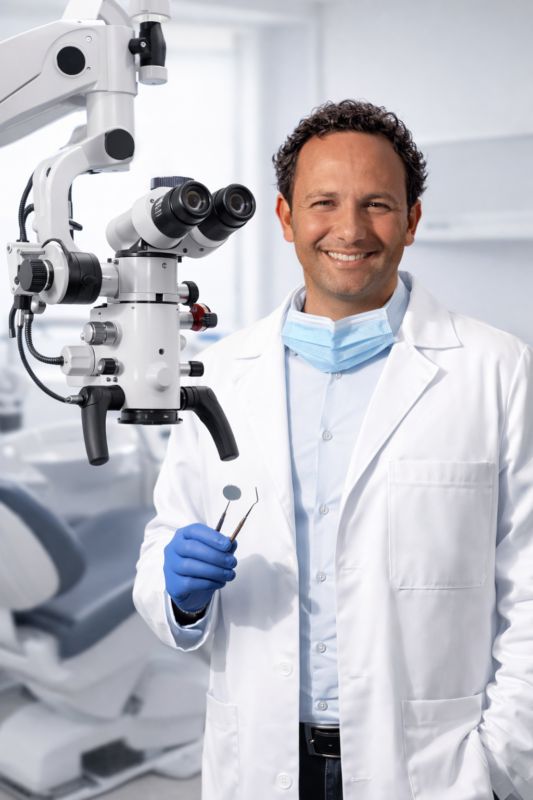
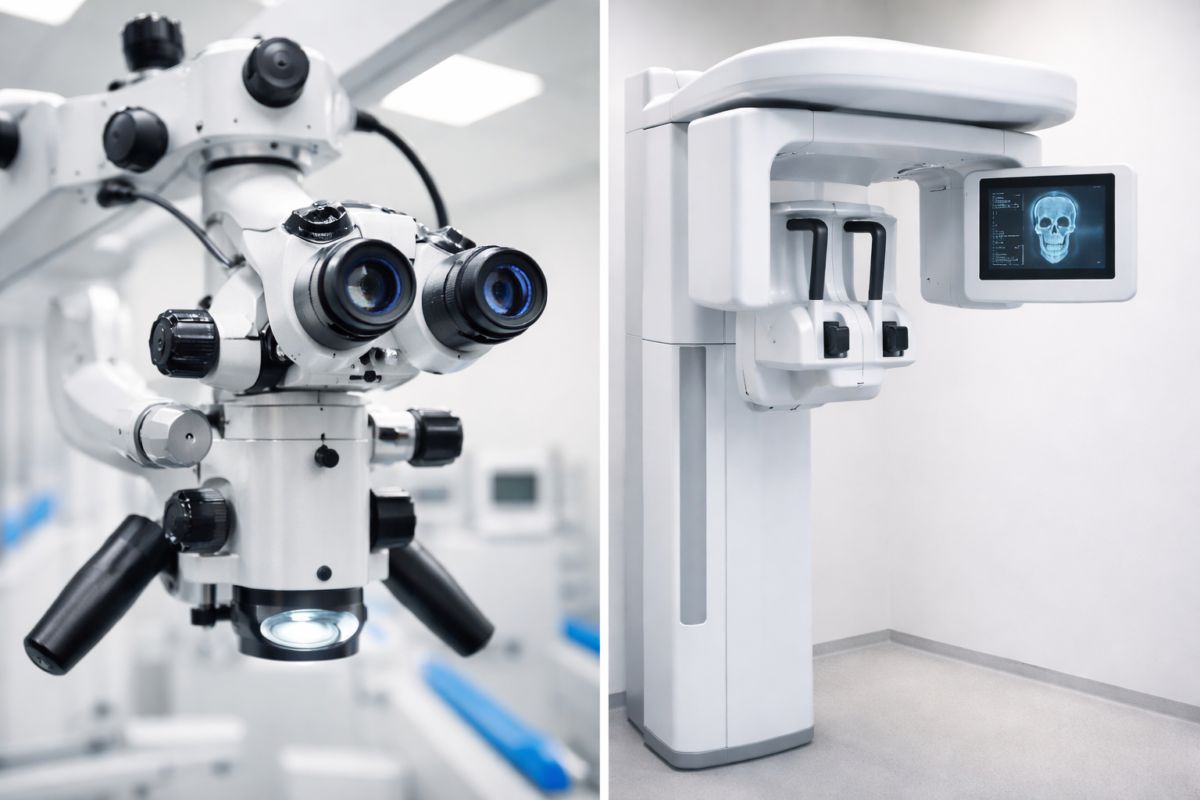
- Dental microscope with up to 25× magnification: we see the finest structures and find hidden or strongly curved canals.
- Rotary instrumentation: modern file systems clean the canals faster and more gently than manual technique alone.
- Ultrasonically activated irrigation: rinsing solutions work far more thoroughly and reach side canals.
- Thermoplastic root filling: the warmed filling material adapts to the canal shape and seals it tightly and permanently.
How treatment works
- Examination and X-ray, discussion of the chances of success
- Local anaesthetic and isolation of the tooth
- Opening the tooth, cleaning and shaping the canals under the microscope
- Disinfection with ultrasonically activated irrigation
- Tight root filling and bacteria-proof seal
- Stable restoration of the tooth, for example with a filling or crown
Re-treatment and difficult cases
Teeth that have already had root canal treatment and cause problems again can often be re-treated. Under the microscope, old fillings can be removed and missed canals found. We will tell you honestly whether saving the tooth is worthwhile.
Frequently asked questions
Is root canal treatment painful?
With local anaesthetic, treatment is usually close to painless. Often it relieves exactly the pain patients come to us with.
How many appointments are needed?
Depending on the tooth and the inflammation, one to three. Rotary instruments and the microscope often shorten treatment time.
What does health insurance cover?
German statutory insurance covers root canal treatment if the tooth is considered worth saving under its guidelines. Services such as the microscope or special irrigation may be charged privately – we discuss this with you beforehand.
Isn't an implant simpler?
In most cases a well-preserved natural tooth is the best solution. Only if a tooth cannot reasonably be saved do we plan a replacement with you.
More treatments
Dental implants
A dental implant is an artificial tooth root that heals firmly into the jawbone and securely supports a crown, bridge or denture.
Learn more →Oral surgery
Some teeth cannot simply be pulled: wisdom teeth stuck in the jaw, teeth that never erupted, or broken teeth with curved roots.
Learn more →Dentures & crowns
When teeth are missing or badly damaged, dentures restore chewing, speech and appearance.
Learn more →Clear aligners
Slightly crooked teeth, small gaps or crowding can often be corrected in adults without fixed braces – using transparent, removable plastic splints called aligners.
Learn more →Prophylaxis & gum care
Treating is good, preventing is better.
Learn more →Children's dentistry
We want to introduce children to dental care – and treatment when needed – in a child-friendly way.
Learn more →Fillings & splints
We treat smaller defects gently and inconspicuously.
Learn more →Make an appointment – online, by phone or by message
Book your appointment around the clock via Doctolib, or call us during opening hours. In our practice we speak German, English, French, Arabic, Kurdish, Croatian and Bosnian.